
4th Sunday in Lent
Texts: Luke 15:1-3, 11b-32;
Josh 5:9-12; 2 Cor 5:16-21
YouTube: https://youtu.be/QhoIS_A5RmY
Sermon Take-Home Notes
THE PARABLE OF THE PERSISTENTLY GRACIOUS AND LOVING PARENT
IN SEARCH OF HER PERSISTENTLY LOST AND ESTRANGED CHILDREN
I’ve shared with you over this past year how much things have changed in Bible scholarship. If I had to sum up the difference in just a few words, I’d say that it’s because it’s not just a good ‘ol boys club anymore. Our understanding of the Bible has benefitted greatly from listening to many voices added to the those that used to monopolize the subject — namely, white men. On this morning’s parable, for example, my favorite treatment of it, chock-full of insights, is by Amy-Jill Levine. Obviously, she’s a woman. But you may have noticed her last name, too. Yes, she is a Jewish New Testament scholar — a really good one. And that alone shows how far off track we had become when all New Testament scholars used to be Christian white men. Consider that nearly all the characters and authors in the New Testament are Jewish — including Jesus! So it has been extremely helpful to have the perspective of Jewish scholars added to the mix.
In any case, one of the things Professor Amy-Jill does in her chapter on today’s parable1 is to spend time upfront talking about the title. We English speaking folks know this morning’s Gospel as the “Parable of the Prodigal Son.” But there’s lots of downfalls to this title, especially since the parable ends with father out convincing the older son to join the celebration. We’re left hanging, in fact. We don’t know how it ends. Does his heart ever warm to his younger brother enough to join the party? Perhaps Jesus told this parable more for the sake of us older brothers, for us to accept the ways of a gracious God. In the German speaking world this parable is known as Der verlorene Sohn, which means, “The Lost Son.” The advantage of this title is that it can be about both sons, each lost in his own way. The two parables we skipped over in verses 4-10 are each about lost things. The shepherd of a hundred sheep goes out in search of one lost sheep. A woman who owns ten silver coins goes out to search for one lost coin. In the parable of the lost son, the father never goes out to search for the lost younger son, though he is eager to welcome him home and celebrate. But the parable does end with him going out to search, if you will, for his lost older son. We might say it’s a story about two lost sons.
 You’re really good as a scholar if you can boil this down to a children’s book. Professor Amy-Jill has done this with a book about Luke 15 called Who Counts?: 100 Sheep, 10 Coins, and 2 Sons. In a note to parents and teachers at the end, she sums up these three parables beautifully and simply:
In our reading, the three stories are connected. The first two stories set up the third. The main message is about counting, searching for what is missing, and celebrating becoming whole again. . . . [T]he father realizes that although his younger son has returned, he has lost his older son. The sheep is returned, and the coin is found. Whether the older son will recognize his father’s love remains an open question.2
When she says that these three parables are about “becoming whole again,” we might think of our Second Reading today, where Paul says that our becoming human in the new creation is all about “reconciliation.” That which is estranged, humankind, is becoming whole again.
In this spirit, I would like to propose a little bit longer title for today’s parable that captures the essence of what I think it is about: The Parable of the Persistently Gracious and Loving Parent in Search of Her Persistently Lost and Estranged Children. Here’s the thing: both sons are lost in different ways but due to the same cause. Both sons fail to understand that their father is persistently loving and gracious. They seem to assume that their father doesn’t have enough love, enough life, to support them both. They assume scarcity rather than abundance.
The younger son demands his portion of the inheritance, assuming he will always be overshadowed by his older brother and never really be allowed to blossom on his own. So he sets off on his own to a far-off country but ends up recklessly using his inheritance such that he finds himself vulnerable to outside calamity: a famine. We don’t have to assume, like his brother does, that he blows all his money on things like prostitutes. But he is reckless enough so that, cut off from home, he can’t survive a famine, a downturn in the economy. He comes to his senses enough to return home and beg for mercy — but only to find out that he doesn’t need to beg, because he has failed to understand that his father’s nature is abundantly merciful and compassionate. His story seems to end happily, with his father accepting him fully as his son and throwing him a big party. But we don’t really see what happens after that. Does the lesson stick? Does he finally understand and embrace his father’s persistent love and grace? Or will he continue to live at home never really trusting that his father’s love is big enough for both sons. After all, isn’t his father outside right now begging his older brother to come into the party? Won’t his father always love his older brother the best? His father is celebrating that he was dead and alive again. But is he? We can’t know unless we see how the younger brother responds to that love. Whether he finally understands and is able to live fully in his father’s abundant grace.
Meanwhile, there’s the older son. We don’t learn anything about him until after his brother returns and the father throws a party for him. Then we see that he, too, might be lost — in a very different way mind you. He has always been the steady son who stays at home, patiently waiting to take over for Dad when the time comes. But he shows himself to be lost for the same reason as his brother: he fails to understand the nature of his father’s way of living in abundant grace. There will always be enough love and life for both he and his brother, but he is failing to trust that. He becomes filled with resentment, bitterness, and feelings of superiority. He thinks himself the better, more faithful son that merits more favorable treatment from his father. His brother wasted the father’s inheritance, while he has remained faithful to it. He deserves more.
The power of this parable is that it understands the importance of how we human beings view the nature of life. Do we need to completely leave behind the human way of seeing things, like St. Paul says this morning. To see that everything is now in a state of being reconciled under God’s grace. We are taught to ask, by our cultures based on merit, Is life ultimately fair? Are our lives based on merit or grace? Is there a God of abundance or scarcity?
I believe that our human nature thus far has tended to see the world in terms of merit and struggle. Our societies are set up as hierarchies, as pyramids with a few people at the top and lots of us in the middle, and even more on the bottom. Do you remember the pyramid of wealth and power we’ve talked about in recent weeks? If we see our lives as on this pyramid, we tend to be lost in the manner of both sons, depending on where we see ourselves on the great pyramid of life. Do we see ourselves as younger children, so to speak, who will always be stuck in the middle or near the bottom, getting less than we deserve? So we take some reckless chances and end up paying for it. But even then, we can turn around and behave like the older brother, too, because there’s almost always someone below us on the pyramid. We can resentfully work to keep those lower than us on the pyramid in their places.
Do you see? In this parable, Jesus is trying to set us free and to see life differently. Our authoritarian, nationalistic leaders may see life in terms of this pyramid, where they are the older siblings in charge near the top. It is their duty to keep everyone in their supposedly god-given places. And the rest of us play the game of vying for a higher place in the pyramid, sometimes like younger siblings trying to get out from under those above us, and sometimes like older siblings trying to keep those below us in their places. But Jesus has come to get us to see life our lives in a fundamentally different way. To give us the path to reconciliation, becoming whole again. Dead but alive again. Lost but now found. We will need to be human in a new and better way. And the first step is to stop failing to see who the Creator truly is: someone who has created enough for all creatures to exist in harmony together. It all comes down to how we learn to understand who God the heavenly parent is — and how we might become more like her.
One of the great books on today’s parable is by Henri Nouwen, titled after the inspiration of his book, namely, a painting by Rembrandt called “The Return of the Prodigal Son.”3 (You can see a picture of that painting in your Sermon Notes. Nouwen sat before the painting for hours and hours before writing his book.) I’d like to end this sermon with author John Dear’s summary of how Nouwen came to write his book — which also acts as a summary of what we’ve been saying here:
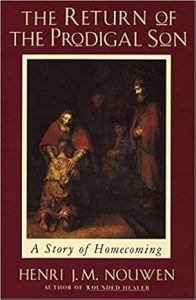 For hundreds of years, people have studied the tale and reflected on the conversion of the prodigal son. Henri Nouwen did that too and spent a year reflecting on his life as the long-lost younger brother. But then one day, while he was sharing his meditation with a friend, the friend pointed out how Henri was more like the resentful older brother. Henri writes that it was a revelation to him. So he spent another year reflecting on the resentment, anger, and bitterness that churned within him. Finally, after he shared his reflections with [another friend], she said, “It doesn’t matter whether you’re more like the younger son or the older son; we need you to be like the compassionate father!” That was the final breakthrough for Henri. He realized that he, and all of us, are called to become as compassionate, loving, welcoming, forgiving, and merciful as the Father. This is Jesus’s image of God, on the lookout for each of us, waiting for each of us, wanting to welcome us back home, hoping to throw a party for us, and pleading with us to turn back from our selfishness, to drop our anger, resentment, and bitterness, come back home, relax, and join the party.
We can ask ourselves, as Henri Nouwen did, Where are we in the story? Are we like the younger son, wasting our lives, far from God’s home, lost and drifting toward death? How can we come to our senses and turn back to God? Are we like the older son — bitter, angry, resentful? How can we become as compassionate, loving, forgiving, and welcoming as the father? How do we celebrate when others come back to life? . . . What is our image of God, and, based on this story, what is God saying to us these days? . . . What keeps us from joining God’s party? Why not swallow our pride, thank God, and celebrate? I hope we can all do the right thing and learn to repent, let go of our selfishness and resentments, welcome God’s unconditional love and compassion, and rejoice, give thanks, and join God’s ongoing celebration of life.4
Amen
Paul J. Nuechterlein
Bethania Lutheran Church,
Racine, WI, March 30, 2025
YouTube: https://youtu.be/QhoIS_A5RmY
Sermon Take-Home Notes
Notes
1. Amy-Jill Levine, Short Stories by Jesus: The Enigmatic Parables of a Controversial Rabbi (HarperOne, 2014), chapter 1, “Lost Sheep, Lost Coin, Lost Son,” 25-70.
2. Amy-Jill Levine, Who Counts?: 100 Sheep, 10 Coins, and 2 Sons (Westminster/John Knox, 2017). The “Note to Parents and Teachers” is at the end (no page numbers).
3. Henri Nouwen, The Return of the Prodigal Son: A Meditation on Fathers, Brothers, and Sons (Doubleday, 1992). There is now a new printing: The Return of the Prodigal Son: A Story of Homecoming (PRH Christian Publishing, 2023). There is also a book titled Home Tonight: Further Meditations on the Parable of the Prodigal Son, published posthumously in 2009 from Nouwen’s notes. I recommend getting the printing that has both these books together in one volume: The Return of the Prodigal Son Anniversary Edition: A Special Two-in-One Volume, including Home Tonight (Convergent Books, 2016).
4. John Dear, The Gospel of Peace: A Commentary on Matthew, Mark, and Luke from the Perspective of Nonviolence (Orbis, 2024), 331.

