
Fourth Sunday of Advent
Texts: Luke 1:39-55;
Micah 5:2-5a; Heb 10:5-10
YouTube: https://youtu.be/fvfHM3BE080
See also the accompanying Sermon Notes
“SON OF GOD”: THE REVELATION OF THE NONVIOLENT GOD OF LOVE
— AND GOD’S POLITICS OF LOVE IN A VIOLENT WORLD
I was pondering several directions for this sermon. Until I received a string of texts from my youngest son Terry, who recently moved to Tacoma, Washington. He asked numerous questions that have very much to do with this Christmas season, this celebration of the Word-made-flesh, the birth of God’s son. Several of his questions had to do with: How can Jesus be considered God’s son and God incarnate at the same time? After raising a series of questions, he simply concluded, “I’m so confused.”
Two days before our Christmas Eve celebrations, I think this is a good time to answer not only my son’s confusion, but also ours. It’s so important to keep these questions in mind and to have an ongoing conversation about understanding this Christmas celebration on which we are about to embark. And I think it can be another occasion to understand how our messaging of the Gospel has gotten off track, how our articulation of the Gospel itself needs an upgrade. I agree that understanding such questions about Jesus as both God’s son and God incarnate have been confusing to folks in the modern world, including us Christians. But here’s how I think we can begin to add some clarity and some oomph to our messaging.
The ways in which Christians in the 21st Century try to explain these puzzles have become too far removed from the experience of the apostles in the First Century. First of all, they didn’t, at least to begin with, have a Christmas problem. They had, to begin with, an Easter problem. That was the first thing they really had to contend with. The fundamental question of the Christian Gospel has to do with who we understand the Messiah to be. I say “we” precisely because I think we’ve lost that moment of deep confusion that the first apostles experienced on Holy Saturday. They were completely confused. We think we know the answers. Rather, over two thousand years later, I believe we’ve lapsed back into some of the same misunderstandings. So let’s place ourselves with the first apostles in the aftermath of Holy Week, trying to understand what it means to be Messiah. The beginning of answers to the Christmas question is to ask with the first apostles the Easter question: Why would God raise from the dead a crucified Jew from backwater Nazareth. We his followers had hoped he was the Messiah. But doesn’t being crucified by the Romans threaten to kill that idea? Messiahs don’t get crucified; they crucify.
So what does Easter mean? What about those who experienced Jesus as risen from the dead? Does Easter mean we have to somehow rethink what happened on Good Friday? Did this mean, for example, that we had wrong the whole idea of what it means to be the Messiah? In other words, did this mean, since “Messiah” is such a thoroughly political term, that we had wrong our entire politics of God’s coming reign? And did this mean that we also had wrong who God is? That God isn’t simply the strongest version of a human emperor ruling over the world? That God isn’t simply king over all the other kings? So that what God reigning in the world means brings about a wholly different experience of who God is and what God’s reign might be about?
Yes, my friends, we’ve once again landed on politics. I believe that the Gospel is all about politics. Mary is hoping for a new kind of politics that favors lowly, oppressed people like herself. The Good News is about the very stark difference between our typical human politics and God’s politics through Jesus the Messiah. As we’ve been saying for months here in our attempts to revitalize the Gospel: If human politics typically resort to hideous violence like crucifying people on crosses, then God’s reign is decidedly not about that sort of thing. In fact, this pinpoints the crucial difference: Human reigns, human politics, fundamentally believe in violence, the power of armies, to maintain order and peace. God’s reign, God’s politics, fundamentally disavows all violence in order to reign through the power of love, the power of creation itself.
So now, continuing to place ourselves with the early apostles, we can come back to the Christmas question: when people of the First Century heard the term “son of God,” what did they hear? You might be surprised to find out that the first thing they heard was a naming of their emperor Caesar. All the Caesars proclaimed themselves to be ‘sons of a god.’ Remember, they believed in more than one god (polytheism). So it was also easier to proclaim themselves to be gods, as all the sons of gods in their mythological stories led people to believe. Such as stories about Hercules son of Zeus, this son of a god and that son of a god. And so it was easy to believe the Caesars when they proclaimed themselves to be sons of gods who came to bring peace and salvation to the Roman people, and therefore to the world. And what did they use to achieve such peace? The most powerful army in the world. Thus, by this thinking, the only religious conclusion that any rational person of that day must reach is that the gods had set the Caesars and their armies in place to rule the world and bring peace through superior firepower, peace through carrying out crucifixions against any and all who would dare challenge such power.
Now, think for a moment about what the Christian claim about “son of God” means in the context of Caesar proclaiming himself to be a “son of a god.” As the apostles in the First Century first began to work out their Easter problem, they eventually got around to puzzling through a Christmas problem. And so we see Christmas addressed in John’s Gospel, and both Luke’s and Matthew’s Gospels. (But not Mark’s Gospel, which was the first one to be written.) If Easter pushed them to rethink what it means to be God’s Messiah, ushering in God’s reign, then that means they had to completely reorient the entire way they thought about both God and politics. Caesar isn’t “Lord.” Jesus is. Caesar isn’t a son of any true God. Jesus is. True politics isn’t about the gods empowering Caesars to violently and oppressively rule over others — the world of inequality and inequity. Politics is about what Jesus shows us: how to be children of our Heavenly Parent such that we come to see each other as equally loved and equally deserving of lives that flourish. It’s about a lowly woman like Mary being lifted up to serve God and her fellow children of God. Like we talked about a couple weeks ago (Advent 2C), politics should be about a making even, a lifting up of the valleys and a lowering of the mountains. It is about a true equity on the way to liberation, where everyone has the opportunity to live lives that flourish.
Like in this picture included in your Sermon Notes. You see that even equality doesn’t quite do the job if everyone is simply given the same box to stand on. As opposed to true equity, where the boxes are rearranged to lift up the lowest. And, finally, we see true liberation, where we don’t need any equalizers because we are all treating one another with equal grace and mutual service.
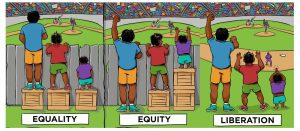
This is what Mary is singing about, as Elizabeth’s child leaps for joy in her womb. She is singing about true equity and true liberation.
So the Christian use of “son of God” is not meant to have us try to think through puzzles like, ‘how can a human being born of simple peasant woman in the First Century also be God?’ It should lead us to think about our politics. Are the politics of all the Caesars throughout history supposed to be our politics — namely, politics based on force where a few at the top violently rule over the rest of us, sacrificing especially those at the bottom or the margins? Or should the politics of Jesus, the son of God, be our politics — namely, a politics of complete nonviolence, of even being willing to suffer imperial violence, in which the power of love rules the day? When we celebrate Christmas as the birth of the true son of God we are essentially getting behind a politics of nonviolently standing against all politics of violence. And in favor of a politics of true equity, where all of God’s children, all of humanity, comes under God’s unconditional love for all of us — God’s loving desire that we all live lives of flourishing.
And when we face the question of — how can the son of God also be God, the Word of Creation made flesh? — we answer in a similar way. How could God’s true politics come into the world if not truly from God? How is it that it was finally revealed to us that the true God is never about wielding the kinds of power used by our human Caesars? The latter is what every human being had been taught to think. How did such a new way to think suddenly break into the world? I don’t think we can overstate the following — this is where my faith has come to peak — that we can’t overstate the revelation through Jesus of God as nonviolent — as love, full stop. Because I believe this is where we Christians have had a relapse: that we’ve become comfortable with both kinds of gods, a God of love and gods of war and violence, too. What we followers of Jesus need to get back is this: that, in this human world based upon violence, somehow it began to make sense to some followers of Jesus, and hopefully to a growing number of us, that God is never about violence. God is always about love. Some of us have come to finally understand that God is completely nonviolent — to the point of loving enemies and suffering our typical human violence on the cross — to understand that the power behind Creation itself is completely that of love. How could any of this revelation of God as love have happened within our violent human history if God were not somehow behind it?
In short, the miracle of Christmas, the miracle that the birth of God’s son reveals to us is that there need be no other power to save this world other than love, even in the face of death, because love is the power of life itself. That’s why John’s Christmas story is not so much in terms of the birth of the Christ child but the birth of creation itself. John places Jesus at the beginning of creation, as the power behind creation. ‘In the beginning was the Word, and the Word was made flesh. . . .’ (John 1:1-14) — we will read this during our candlelight Christmas service, as we light our candles. For this is the light of the world, that God’s power of love is the power to make life itself. It is the power to make everyone into children of God. We are sons of God, we are daughters of God, when we learn to live by a politics of love. Amen
Paul J. Nuechterlein
Bethania Lutheran Church,
Racine, WI, December 22, 2024
YouTube: https://youtu.be/fvfHM3BE080

